





Introduction : From castle to steeple, mapping lines to see better
France is a country where history, architecture and landscape are constantly conversing. From the sweeping silhouettes of Loire Valley châteaux to the sharp spires of Norman steeples, every building offers a web of lines — horizons, leading lines, shadow seams — that travelers and photographers can use to craft lasting images and impressions. This piece is a practical, wide-ranging guide to spotting, analyzing and making the most of those lines and perspectives in different settings: castle gardens and moats, medieval lanes that funnel to a steeple, town squares and rural lookouts.
We’ll cover compositional theory (rule of thirds, symmetry, diagonals, natural frames) as well as real-world applications in well-known spots, with exact addresses, opening times, entry prices and local tips. The aim is twofold: help you improve your framing for photographs and deepen your visit — because understanding how lines work changes how you walk through a castle, position yourself before a façade, or wait for the light to hit a steeple at dusk.
This guide is for curious travelers, amateur photographers and architecture fans. It doesn’t aim to be exhaustive, but it gives reliable, actionable pointers: where to stand on the avenue leading to a château for perfect symmetry, when the sun casts the longest shadows across a cathedral nave, which angle isolates a spire against a dramatic sky. We’ll also share local advice — parking, pedestrian access, lesser-known viewpoints — so you can make the most of your time and respect the heritage.
Finally, to make this guide immediately usable, each section includes precise locations with full addresses, prices in euros and opening hours (publicly available at the time of writing), plus practical recommendations for lighting, lenses (wide-angle vs. telephoto) and basic settings. Lace up your shoes, pack your tripod and sharpen your eye: from grand châteaux to modest steeples, there’s always a line waiting to be used.
Understanding lines and perspective: applied principles
Before you head out, it’s useful to recap a few key ideas. By “line” we mean any visual direction the eye follows: an aligned avenue, the break between roof and sky, a series of arches in a cloister. Perspective is how those lines converge — toward a vanishing point, toward a central balance, or into a rhythmic checkerboard. Mastering these elements lets you guide the viewer’s eye and tell a coherent visual story.
Some concrete principles:
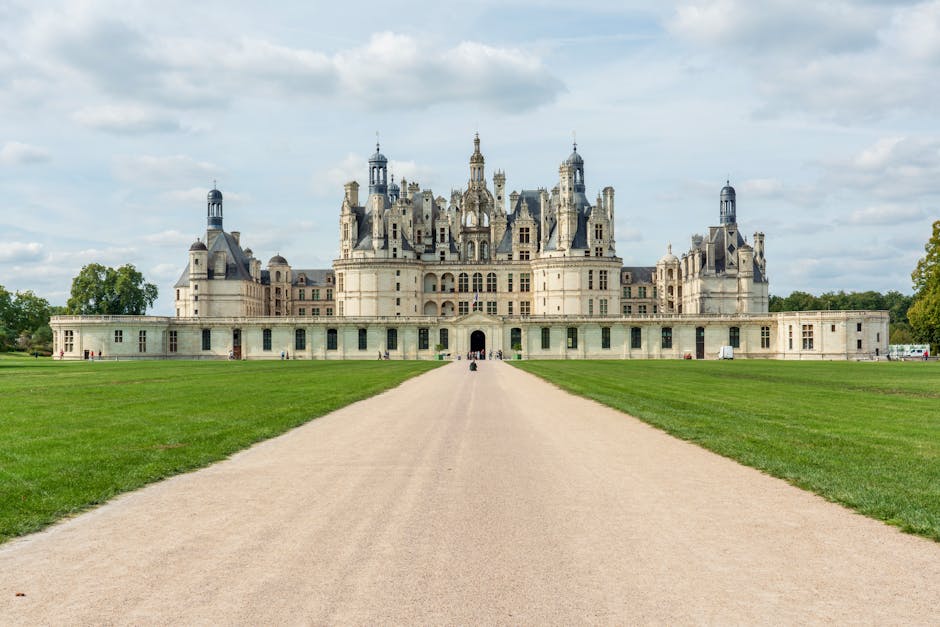
- Central symmetry: highly effective in front of château façades like Château de Chambord. Stand exactly on the central axis to achieve a mirror composition. Address: Château de Chambord, 41250 Chambord, France. Hours: generally 09:00–18:00 (season-dependent). Indicative price: ~€15.00 adult (castle visit; reduced rates often available on site).
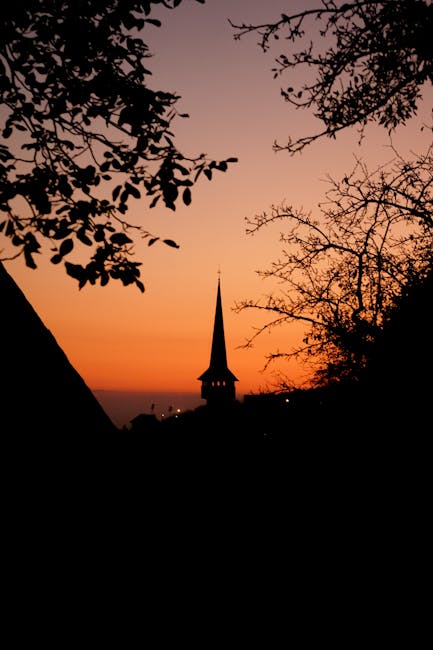
- Leading lines: use them to direct attention toward a steeple or a tower. Put an avenue, wall or row of trees in a corner of the frame so they lead toward the focal point. Rue du Gros Horloge in Rouen works especially well for this kind of shot.
- Natural frames: doorways, arcades, branches and gates help frame a distant steeple, creating depth and hierarchy.
- Contrast and texture: restored stone on a château, slate on a steeple, the metal of a pinnacle all react differently to light. Look for the “line of contrast” where material and light create a crisp separation.
Practical tip: for a pronounced perspective, use a wide-angle and get close to your foreground; to isolate an element (a spire, a dormer), use a telephoto and compress the scene. Local tip: in busy tourist areas, arrive 45 minutes before opening to have the forecourt to yourself and line up your elements without crowds.
Lines and châteaux: concrete examples in the Loire Valley
The Loire Valley is an ideal learning ground. Its châteaux offer axial avenues, reflective moats and geometric gardens — all elements that create strong lines. Here are three castles examined for their perspectives.
Château de Chambord
Address: Château de Chambord, 41250 Chambord, France. Hours: 09:00–18:00 (outside special seasons). Price: about €15.00 adult for the interior tour; park and gardens may be accessible separately (prices vary).
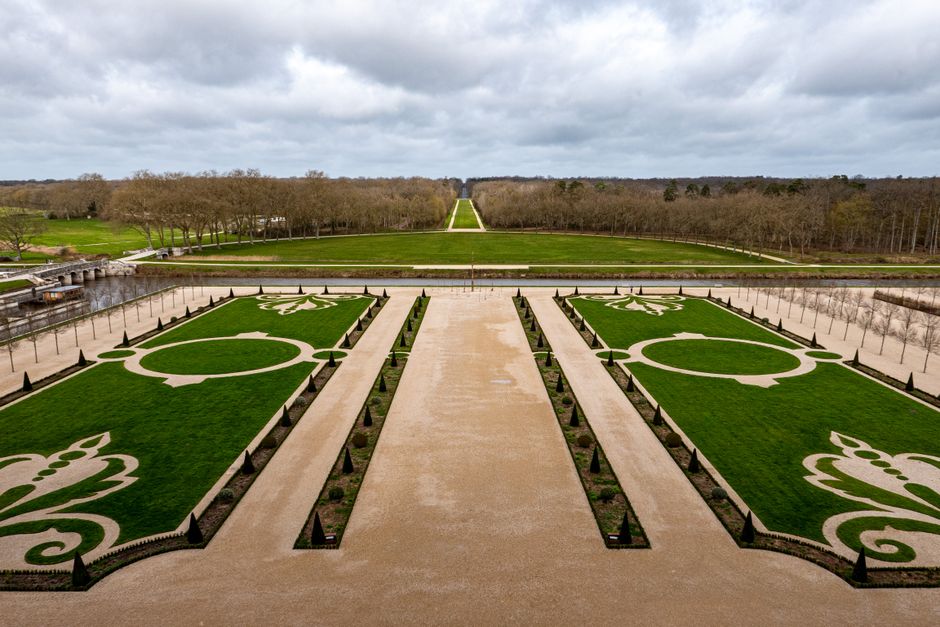
Description: Chambord’s vast façade is organized around very clear axes. The central avenue lined with plane trees, the symmetry of the towers and the complexity of the roofs produce horizontal and vertical lines you can exploit. Shooting idea: look for a slightly elevated viewpoint (a small lookout or a paid level in the park) to capture the full symmetry with the gardens in the foreground. The reflection in the moat early in the morning reinforces that symmetry.
Château de Chenonceau
Address: Château de Chenonceau, 37150 Chenonceaux, France. Hours: 09:00–18:30 (season-dependent). Price: around €17.50 adult for the château and gardens.
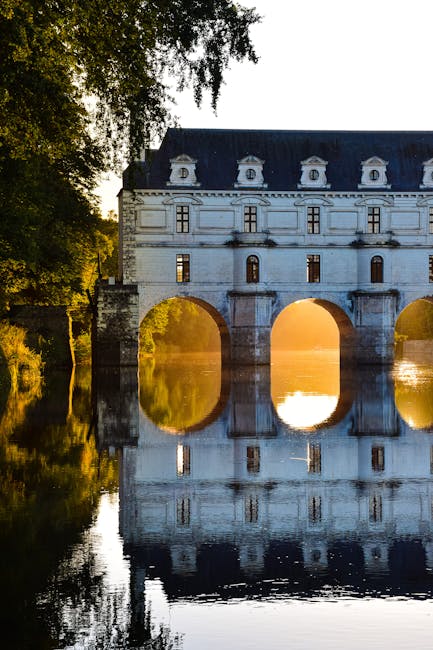
Description: spanning the river Cher, Chenonceau is a perfect example of architecture interacting with water. The arches crossing the river create repeated horizontal lines and reflections. For perspective, stand on the opposite bank at sunset, use a long focal length to compress the arches and isolate the reflections. Local tip: the path along the Cher on the east side offers less crowded views than the main forecourt.
Château d’Azay-le-Rideau
Address: Château d’Azay-le-Rideau, 37190 Azay-le-Rideau, France. Hours: 10:00–18:00 (variable). Price: about €10.00 adult.
Description: more intimate, Azay-le-Rideau creates a close dialogue between the monument and its pond. The curved lines of reflections and breaks in the vegetation lend themselves to layered compositions. Vary focal lengths and use boats and docks as foreground elements.
From steeple to street: urban and village perspectives
Steeples are often dominant vertical anchors, contrasting with the horizontal grid of roofs and streets. They serve as visual anchors: the challenge is integrating them into a composition that tells the story of the place. Here are some pointers and specific locations.
Cathédrale Notre-Dame de Chartres
Address: Cathédrale Notre-Dame de Chartres, Place du 18 Octobre, 28000 Chartres, France. Hours: access to the cathedral varies, generally 07:00–19:00; tower and crypt visits are paid. Tower price: about €6.00 adult to climb the bell tower (if open).
Description: the twin western façade and its unequal towers create a strong upward pull. The lanes that slope toward the cathedral offer converging lines perfect for leading the eye. Tip: in the morning, from the forecourt the side light sculpts the sculptures and deepens the shadows, emphasizing verticality.
Rouen, Rue du Gros-Horloge and Rouen Cathedral
Address: Gros-Horloge, Rue du Gros-Horloge, 76000 Rouen, France. Hours: shops and the pedestrian street are freely accessible; don’t forget the cathedral at Place de la Cathédrale, 76000 Rouen. Price: cathedral access is free; certain guided tours cost around €5–8.
Description: Rue du Gros-Horloge creates a historical perspective that guides the eye from the shopping square up to the cathedral’s spire. Half-timbered buildings set a vertical rhythm. Idea: use a standard lens (35–50mm) to keep a human perspective and let the steeple emerge gradually.
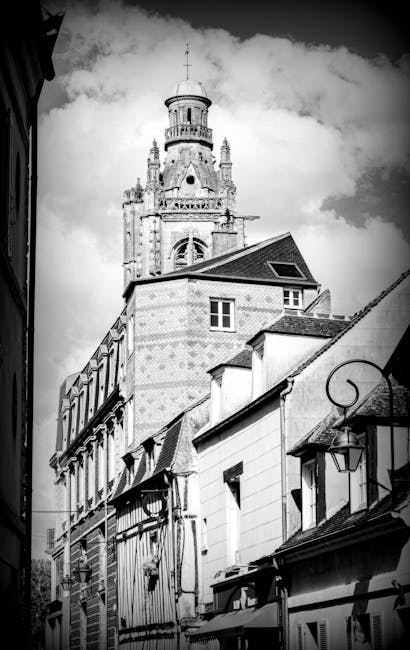
Photo routes and practical tips for using lines
Planning your shots means planning your movement: times, access points and light conditions. Here are practical tips to turn observation into tangible results.
- Timing: favor the golden hour (roughly the first 45 minutes after sunrise and the last 45 minutes before sunset) for warm tones and long shadows that exaggerate lines. For reflections, calm mornings are often best.
- Gear: a lightweight tripod for long exposures (especially for reflections and moving skies), a wide-angle for courtyards and close façades, a telephoto (70–200mm) to isolate a steeple above the rooftops.
- Settings: f/8–f/11 for extended sharpness; low ISO (100–200); use aperture priority or manual mode depending on the situation.
- Respect the site: many landmarks restrict photography in certain areas (sensitive interiors, ceremonies). Check at ticket desks: for example, the Château de Chambord visit may require following marked routes. Prices and hours can change; check official sites before you go.
To wrap up this practical section: trace your lines before you press the shutter. Walk around your subject, change height, use foreground elements (benches, gates, statues) to anchor the image. And above all, give yourself time: sometimes the perfect line only reveals itself after ten minutes of looking.
Conclusion: seeing France through its lines
From castle to steeple, lines and perspectives are the most accessible tools to see more clearly and tell better stories. They reveal builders’ intentions, shape collective memory and simplify photographic composition. By combining a careful reading of forms (symmetry, diagonals, frames) with thoughtful movement (change height, wait for light), you can turn a routine visit into a sensitive, photographic experience.
This guide aimed to offer not only principles but also concrete examples with addresses, hours and prices so your exploration can start right away. Whether you’re shooting the imposing silhouette of the Château de Chambord (Château de Chambord, 41250 Chambord) or searching for the spire that pierces the sky from a lane in Rouen (Rue du Gros-Horloge, 76000 Rouen), remember that the strongest line is the one that tells a story. Respect the sites, check opening times (they vary by season and events) and get out early to catch the most photogenic light.
Finally, leave room for the unexpected: a fleeting reflection, dramatic clouds behind a steeple, or a sunbeam slicing through an avenue can turn a good picture into a memorable one. Note your favorite spots, swap framing tips with locals (often full of useful hints) and return at different hours: the same façade offers new lines every day.